The Supreme Court’s Order on AIFF Constitution: Through a Layman’s Eyes
The Supreme Court’s recent order approving the new Constitution of the All India Football Federation (AIFF) is a powerful, deeply thoughtful document that reimagines sports administration through a lens of public interest, inclusivity, professionalism, and institutional accountability. Far more than a technical verdict, it sets a pro-people, forward-looking template with profound implications—not only for Indian football but for the governance of sport in India as a whole. I tried to look at it through a layman’s eyes and as someone who has been following Indian football for a long time. There is no question that it is a very progressive verdict. Does it curtail the All India Football Federation’s rights to monetize the sport? Maybe. Will it earn the FIFA wrath because of certain clauses in it? Maybe. But at the end of the day, if you read through the order, it sets clear standards for AIFF to function with utmost transparency and accountability. As fans of Indian football, we should appreciate the court for the standards it has set and, in the process, put various stakeholders like the state FAs who were “vehemently” against various measures of accountability the new constitution has proposed.

Setting a Vision for Indian Football and Sport

The judgment opens with a sweeping historical reflection, charting football’s journey in India and invoking powerful constitutional values. Referencing leading sociological and legal works, the Court recognizes sporting facilities and opportunities as “material resources of the community” and describes organizing bodies as “institutions of the national life.” By framing sporting spaces as “places of public resort,” the order affirms their role in social progress and collective well-being.

The Court underlines a vital constitutional duty: to ensure that sporting opportunities are “accessible, not just for pursuing sport, but also for its administration.” It calls upon the State for a deeper Sadhana—a continued, determined endeavor—to cultivate sport with “efficiency, integrity, professionalism, and expertise.” In pointed language, the judgment insists on democratizing access to both athletic and administrative opportunities, emphasizing that facilities and revenues must not be cornered by the urban economic elite, but rather “be distributed to subserve and encourage accessible and affordable sport in our country.”

A Candid Appraisal of Past Failures and Grassroots Activism

The order does not shy away from critiquing past governance. The Court bluntly observes that the AIFF “failed to evolve with time,” delayed its global affiliations by over a decade, and allowed the sport to fracture along political and regional lines, thereby alienating key stakeholders such as players. This honest reckoning honors individuals like Rahul Mehra, whose tenacious litigation efforts helped catalyze reform and details the years-long journey that brought about this historic shift—including the vital contributions of Justice L. Nageswara Rao, whose BCCI reform experience deeply informed the drafting process.

A Forum of Inclusive Stakeholders: Redefining the General Body

One of the order’s greatest strengths is its insistence on inclusive governance. The draft Constitution provides for a General Body that includes:

  • 1 representative from every state Member Association,
  • 15 elected “Eminent Players” (with a minimum of 5 women),
  • 3 club representatives (from ISL, I-League, and the Indian Women’s League),
  • Referee and coach representatives of both genders.

Despite opposition from both the AIFF and state associations, the Court finds inspiration in recent FIFA statutes that encourage broad-based stakeholder involvement. It firmly asserts that including players, coaches, referees, and clubs can only “herald transparency and fair play.” This approach aligns the AIFF with best global practices, where federations open their doors to diverse voices crucial for modern, ethical sports governance.

Transparency, Merit, and Women’s Representation in Recognition

The judgment exposes a surprising gap in AIFF’s recordkeeping: a near-total absence of historical data on national team players. The court decries this as a symptom of past mismanagement—a compelling reminder of why professionalization and transparency are urgently needed. As for the Executive Committee, the order backs a sizeable inclusion of eminent players, with a gender quota to ensure meaningful women’s participation. The number of Vice Presidents is set at three, again with gender representation, to prevent politicized regional gatekeeping.

Aligning the Pyramid: Constitutional Application to State Associations

Unlike the popular narrative that the Supreme Court heavily relied on earlier verdicts on BCCI to form this constitution, it has to be highlighted that SC showed incredible nous in making the following remark: “However, the present case of Indian Football, which benefits immensely from a pyramidical structure, is placed on a different footing than the game of cricket.” Recognizing that reform at the top means little unless echoed below, the order mandates that state football associations bring their constitutions into line with the AIFF’s every two years. This safeguards against exploitation of loopholes (like “cooling-off” circumventions or shadow appointments) and upholds the pyramidical integrity of Indian football—from the grassroots to the national team.

Guarding AIFF’s Autonomy: Limits on Private Delegation

The most interesting part of the judgment is about the commercial exploitation of its rights through third-party entities. A Guardian article from 2012 notes the following regarding corruption in football: “National football associations, federations, and confederations own the broadcast and marketing rights to the national teams that everyone likes to follow. The elected officials in these organizations are supposed to use the revenues they generate to support the development of the game – but many seem to want to enrich themselves instead. Here’s how it works: accepting bribes is against the rules of all these organizations, so they cannot take the payment directly. Instead, they arrange for the federation to sell its rights to a marketing company, which in turn sells the rights to broadcasters, sponsors, and so on. In doing so they pass on a share of what they make to the federation officials.”

This puts the deal which AIFF entered in to with FSDL, a subsidiary of Reliance Industries under a shadow of doubt.  The tender document nor the agreement was available publicly until someone leaked the MRA contract pages online. With this judgment, what the court has emphasized is that such deals with third parties should follow due process and AIFF should not absolve its rights while engaging in such deals. The court noted that in the existing MRA, FSDL was allowed to set up the senior-most league of football in India and decide on its own wisdom the “format, rules, and structure of the league and the teams and players which will compete in it.” In this view, FSDL had virtually acquired the right to commercialize each and every aspect of the new league which should not be permitted.

The Court is unequivocal: while AIFF can work with commercial entities for the monetization and promotion of the sport, its essential governing responsibilities are non-delegable. The days when a private party could control the senior-most league’s rules, entry, or format—essentially becoming the shadow federation—are over. The judgment fortifies the primacy of AIFF by upholding strong definitions of “essential aspects,” and blocks future attempts to privatize the sport’s regulatory structure. Commercial interests must be balanced by the protection of public goods and sporting values. While this could be termed very conservative in its nature, it is very important that the sport retains its inclusivity and should not be at the behest of the whims and fancies of a third-party private entity which was the case in the last decade for Indian football and this will be attested to by a lot of stakeholders in the Indian football ecosystem.

Ensuring Positive Competitive Structure: Promotion, Relegation, and Governance Shields

The Supreme Court offers an emphatic endorsement of open competition as the lifeblood of Indian football. Defining the top division league as one “owned, operated, and recognized” by AIFF and governed by promotion and relegation, the order outlaws any return to “closed league” structures or regulatory gerrymandering. Attempts to dilute this principle, whether by invocation of inapplicable foreign precedents or by commercial privilege, are firmly rejected as the court invoked the 2019 decision taken jointly by AFC, AIFF, and FSDL wherein relegation and promotion in the topmost league was agreed upon by the 2024-25 season. The court went on to note that “Taking into account the fact that Indian football began way back in time and also the fact that Indian sports have flourished with time, it is an opportune moment to decide that hereon, Indian football will not be played in silos.”

Amendments and Safeguards: The Role of the Court

Perhaps most notably, the Court introduces a “safety valve” to prevent future dilution of these hard-won reforms. No amendment to the AIFF Constitution can be enacted without a 75% majority and the leave of the Supreme Court. Yet, the Court clarifies that ongoing micromanagement is not its role; its present intervention is a finite, but essential, safeguard to ensure the proper foundational norms are respected as Indian football enters a new era.

A Vision for the Future: Building a Thriving Sporting Nation

The order closes with a message of hope, vision, and collective responsibility, affirming the enormous potential of India’s sporting talent and the need to channel it with “organizational support… from village fields to international platforms.” By laying down a bold, transparent, and equitable constitutional architecture for Indian football, the Supreme Court’s order gives reason to believe that the mistakes of the past can yield to a future of greater integrity, vibrancy, and competitiveness.

Conclusion

This judgment is, indeed, a monumental charter for sporting democracy in India. It recognizes the deep sociological significance of football, upholds the cause of transparency, merit, and gender equity, and places the governance of the game back with those to whom it truly belongs—the community of players, coaches, referees, and fans. The current narrative of this constitution being overly dependent on former verdicts on BCCI lacks merit. Well, the order does point to earlier rulings on BCCI at various junctures, but it is very mindful that it is dealing with football, and it has to be treated differently. There are instances where this is laid bare in the order too. The reading that this order places undue importance on BCCI is very frivolous and platonic in nature. The order provides a constitutional framework not just for AIFF, but as a model for public-spirited, constitutionally sound sports governance nationwide. In restoring faith and vision to the landscape of Indian football, the Supreme Court has underlined its role not only as an arbiter of law but as a champion of good governance and the public good. The questions of whether this order and the draft constitution will survive a FIFA ban or will it restrict the All India Football Federation’s capability of monetizing the game stand. What we can be assured of is that the Supreme Court has laid bare a system with proper checks and accountability with this order and this is something that should reassure us as fans.
The Systemic Annihilation of the I-League: How Mismanagement is Destroying Indian Football’s Second Division

The 2024–25 I-League season should have been a celebration of progress for Indian football. Instead, it has spiraled into a case study of dysfunction—marred by legal disputes, inconsistent rulings, and shattered credibility. Once regarded as the backbone of Indian football’s development pathway, the I-League now finds itself stuck in a quagmire of mismanagement and administrative neglect.

Namdhari FC and the Cledson Silva Ineligibility Dispute

Yet another blow came when Namdhari FC fielded an ineligible player, Cledson C. Silva, in a match against Inter Kashi.

  • The AIFF Disciplinary Committee awarded Inter Kashi a 3–0 win by forfeit.
  • The AIFF Appeals Committee reversed the decision, citing procedural errors.
  • Like the Barco case, this issue is now escalated to the Court of Arbitration for Sport (CAS).

Due to these unresolved legal entanglements, the AIFF is unable to declare an official I-League champion or even hold a medal ceremony. As of June 2025—two months after the last match on April 6—there is still no winner. This marks an unprecedented collapse in Indian football’s administrative history.

Inter Kashi and the Mario Barco Controversy: A Legal Quagmire

The most high-profile controversy of the season involves Inter Kashi’s Spanish forward, Mario Barco Vilar. Initially registered and then replaced due to injury, Barco was curiously re-registered mid-season, flouting existing AIFF regulations.

  • The AIFF League Committee approved his return.
  • The AIFF Appeals Committee later declared the move invalid.
  • Consequences: Inter Kashi were docked four points, and Churchill Brothers were named provisional champions.

Despite the decision, the championship remains undecided, as the dispute awaits resolution at CAS—months after the league concluded.

Disciplinary Disarray and Governance Failure

The season has exposed deep flaws in AIFF’s judicial bodies. The Disciplinary and Appeals Committees have delivered erratic, conflicting verdicts, shaking the league’s structural integrity. The fate of Delhi FC and Sporting Club Bengaluru—both facing potential relegation—remains in limbo. These inconsistencies have paralyzed the league and demonstrated a serious lack of professionalism and accountability in football governance.

The Bigger Picture: Institutional Rot and AIFF’s Leadership Crisis

The I-League chaos is not an isolated incident—it reflects deeper systemic issues within Indian football:

  • The AIFF constitution is still under review by the Supreme Court.
  • The media rights deal with FSDL/Reliance is nearing expiry, with no public roadmap.
  • AIFF President Kalyan Chaubey faces intensifying criticism, with fans tracking his unfulfilled promises—ranging from youth development to better infrastructure.

Platforms like Reddit and X (formerly Twitter) are now home to fan-led investigations, accountability threads, and growing public disillusionment with the AIFF regime.

Why the I-League Still Matters—and Why Its Survival is Critical

Despite the chaos, the I-League remains an essential pillar of Indian football:

  • It offers a lower-cost investment option for clubs compared to the Indian Super League (ISL).
  • It provides a pathway to ISL promotion, which, if properly managed, could incentivize serious investments.
  • It serves as a platform for emerging Indian players, coaches, and smaller clubs to gain national visibility.

But without immediate reforms and structural clarity, these benefits risk being permanently lost. Mismanagement—not competition—is what threatens the I-League’s future.

Conclusion: Rebuild or Relegate to Irrelevance

The I-League is not merely in crisis—it is being systematically dismantled. The 2024–25 season has laid bare the incompetence, opacity, and dysfunction at the heart of Indian football administration.

Unless the AIFF takes swift and transparent action, the I-League will continue its descent—not because of failure on the pitch, but because of deliberate negligence off it.

Rising to the Top: Kishore S Reddy on Sporting Club Bengaluru’s Remarkable Journey

We recently caught up with Kishore S Reddy, CEO of Sporting Club Bengaluru, to discuss the club’s impressive journey, his personal football experiences, and future aspirations. In this insightful interview, Reddy shares the club’s rapid ascent through the ranks, the importance of local talent, and how Sporting Club Bengaluru aims to make a lasting impact on Indian football.

Q: Can you give us a brief overview of Sporting Club Bengaluru’s journey so far?

Kishore S Reddy: Sporting Club Bengaluru has had an exciting journey, marked by significant achievements and growth. In the 2022-23 season, we debuted in the Bengaluru Super Division league and emerged champion, and qualified for the I-League 2. That’s when AIFF rejigged the pyramid and introduced I-League 3. We topped the group after edging Diamond Harbour and then went to finish inn the top 3 of I-league 3 and qualified for I-league 2. In I-league 2, we competed with very strong teams, won 11 out of 14 matches and emerged winners there by securing the qualification to I-league. All in a span of two odd years.

Q: Tell us about your early football experiences in Bengaluru.

Kishore S Reddy: For me, I’ve always been passionate about football, influenced by my family’s army background and my uncle, who played football in the intra-services. My sports journey started pretty early in my life as I started off in athletics and winning laurels in sprinting and other disciplines. I had started playing football too way before our family settled in Bengaluru. In Bengaluru, my sporting life took off at KV DRDO, CV Raman Nagar, where I participated in athletics and football and won medals for the school in various competitions. Just as many in my generation, I got Inspired by Maradona, and my love for football only grew through my school, college, and university years. In Bengaluru, we had smaller tournaments where even professional players and semi-professional players participated. I had a team called Anti-Virus, and we played in a lot of these tournaments and got introduced to many of the talents in Bengaluru. Unfortunately, I had to stop playing due to an ACL injury. During my playing time, I observed professional players from HAL and BEML, which fuelled my fascination with Indian football, especially in the early 2000s. I met players like Alex Praveen, who is also the assistant coach of SC Bengaluru now and Chethan Kumar, who was captain of Karnataka Santosh Trophy during my playing career in Bengaluru. In 2014, when Ozone FC came into existence, and I represented many of these talents and placed them in Ozone FC which went on win the Super Division Title in the debut season itself.

Q: How did you transition from playing to managing and promoting football?

Kishore S Reddy: My transition began in the final year of my engineering when I joined Kshatriya Sports in 2013 and worked there for a year. That is where I my met my future business partner Prithvi Ramakrishnan as well. During that period Bengaluru was witnessing an artificial turf boom as well. This got us thinking, and we got involved in the pay & play scene for a while. Most of the football plating nations have strong amateur league or Sunday leagues but in India we lacked that. We saw an opportunity there and started The Amateur League (TAL) in 2014, which went on to become a big hit that we expanded even to Delhi in 2016.

Q: How did Sporting Club Bengaluru come into existence?

Kishore S Reddy: Post-pandemic, we brainstormed about the direction that TAL needs to take. I had some thoughts regarding establishing a professional team in Bengaluru and I divested my stake in Sports Paddock, the parent company of TAL and set out to realize my ambitions.  I did a lot of research at that point and realized that in the next decade or so, ISL clubs are likely to break even, and there’s potential for promotion to the ISL from I-league. I started scouting for investors to set up a professional club, and in early 2022, we collaborated with Sporting Group International from the UK. Their CEO, Mr. Adrian Wright, who was also a former board director at West Bromwich Albion, along with his partners Kulbir Sohi and Tony Sohi, invested in the club in a personal capacity and established Sporting Club, Bengaluru.

How important is the “local connect” factor for Sporting Bengaluru?

Kishore S Reddy: It is very important for Sporting Bengaluru. We are always on the lookout for local talent and promoting them. So far, we have given a lot of opportunities to local talent and will continue to do so in the future. I have a very interesting anecdote to share in this regard. In our 2022-23 debut BDFA Super Division League season, we took on Kickstart FC, yet another side from Bengaluru that promotes local talent. That match drew around 3,000 spectators to the Bengaluru Football Stadium, which is a testament to the fact that we are always trying to promote local talent. Additionally, the good work we’ve done with TAL, including the first Baby League at FSV, has built a strong foundation and goodwill for us.

Q: What’s your approach to recruitment and team building at Sporting Club Bengaluru?

Kishore S Reddy: Our recruitment is heavily data and technology-driven. I’ve drawn inspiration from other figures in the Indian football ecosystem, like Gokulam Kerala FC’s president VC Praveen, and observed the methods of those who have successfully built teams. Internationally, we want to emulate clubs like Brighton and Brentford, who recruit young talents, develop them, and then sell them to make profits. We have already managed to do that with some young talent. We focus on having a strong foundation and continually redefining our strategies. For the I-League, we are looking for young, promising foreign signings who add value without compromising our principles. We have a mix of Karnataka players and talent from across the country.

Q: What are your thoughts regarding the BDFA Super Division League?

Kishore S Reddy: The BDFA Super Division has significantly improved under Mr. N.A Harris and M. Satyanarayan’s leadership, and this is what has translated into Karnataka’s success in the Santosh Trophy.
Now, Karnataka has one of the best youth leagues – YPL that is being conducted for various age groups, and for the seniors the Super Division, A, B and C division league with many clubs vying for the title. The ecosystem in Bengaluru is really thriving. Now, talents across the country are ready to come and play in Bengaluru because playing in the Bengaluru league opens many opportunities for them.

Q: What are your future plans for Sporting Club Bengaluru?

Kishore S Reddy: Our plan is to push for the I-League title, and we are planning to play the matches at the Bengaluru Football Stadium, hoping to draw a good amount of support for our team. We have managed to achieve so much in this short span of time, and there is only one trajectory for us: upward. The support from the local community and our focus on leveraging data and technology will play crucial roles in our success. Our ultimate goal is to make a significant impact on Indian football and provide a platform for young talents from Karnataka to shine.

I-League champions, Aizawl FC, appoints Portuguese Paulo Menezes as Head Coach

Aizawl FC, Indianfootball, Football, Mizoram, Aizawl, India, Soccer, Portugal, Spain, Coach, Manger, Paulo Menezes, i-league

Portuguese coach Paulo Menezes ​appointed as the manager of I-League champions, Aizawl FC for the 201​7/18​ season.

​Paulo was part of the coaching setup which masterminded the triumphs of the invincible Spanish National Team in the Confederations Cup, FIFA World Cup and European Championship during its golden era (2013 to 2016).

“When my representatives,  Trebol Sports Internat​ional ​informed me about this opportunity, I did not even think twice about it. ​​I have learnt about Indian football since 4 years ago and I have spoken to many people about it and how much it has grown over the years.  I want to be part of this and Aizawl FC is right at the heartbeat of this crescendo of development”.

The 39-year-old Portuguese acknowledged that Indian clubs have improved a lot during the past few years but in order to reach the pinnacle, they need to to adopt the organizational structure of a European club.

“Clubs must be receptive to the idea of developing many departments- scouting, marketing and the most important thing, a youth academy.

​I believe that in order to be the best club in the country or this region, it is a must to build a strong academy. From the junior to the senior teams, they must adopt the same game model and tactical system so that there is consistency of play throughout all levels. The assimilation of youth players to a senior level will then become a seamless process”.

As a former Vicente del Bosque’s coaching staff, it is no surprise that Paulo adopts the same football philosophy as the fearsome La Roja.

“​I will like my players to play the offensive game with a high level of ball possession so that they can create many scoring chances.  Depending on the game situation, we will vary the tempo of our attack but the main focus is on ball rentention”.

Besides plans to impose his Model of Game on the team and improve the club footballing structure, the former World Cup winner is also interested in developing the capabilities of the local players.

“I will like to help the players improve their skills- be it technically or tactically, so they can become more competitive and maintain a strong mentality before and during the game.  ​I believe I can contribute to Indian football by getting as many of the  local players into the National Team as possible.  I derive an immense sense of pride whenever I see my players put on their national colours.”

Pending his visa approval, Paulo is expected to arrive in Aizawl early next week to assume his new role.

East Bengal pinning hopes on Khalid Jamil

East Bengal, Football, Khalid Jamil, I-league, Soccer, Kolkata, Indianfootball

After a great season with the Mizoram side Aizawl FC, Khalid Jamil will descend the north-eastern hills to take over the Kolkata side East Bengal. Khalid performed magic with Aizawl FC by guiding them to the summit of the I-league, whereas East Bengal had a season to forget as their challenge under Aussie coach Trevor Morgan petered out in the final phase of the league.

Khalid Jamil will be eager to prove himself by managing a Kolkata club and ascertain that his incredible run with Aizawl FC was not just a flash in the pan. According to reports, Khalid has signed a deal worth 1.25 crores for two years, which will make him the highest earning Indian coach ever.

There is a lot of uncertainty regarding the upcoming football season, but East Bengal has been very quick in snapping up players and the head coach. A positive sign, as the club, seems to be taking the CFL campaign that will start in August quite seriously. A good performance in the CFL could be a good platform to build upon for the other bigger challenges that are awaiting the team in the next season.

East Bengal roping in the I-league winning coach shows a positive intent from the club, and this also offers some relief for their fans and the supporters of other I-league clubs as well. With news of clubs pulling out and shutting down flying thick and fast, this move by East Bengal might just force some other clubs to rethink their options and might want to test the waters for some more years.

After a lot of drama, East Bengal missed out on their chance to play in the Indian Super League due to differences on certain terms they had to agree to join the league. And with AIFF scheming to hold both the leagues (ISL & I-league) in parallel, there are concerns that I-league clubs will not be able to retain the best players as they will struggle to compete with financially sound ISL franchises. However, Khalid Jamil remained entirely oblivious to these changes as he quipped “Football will remain the same, be it ISL or I-League,” during the unveiling.

East Bengal has not had the best of its time in the top tier of Indian football ever since National Football League was re-branded to I-league in 2007. With a set of an explosive fan base and an equally crazy management to deal with, it would be interesting to see how Khalid Jamil’s foray into Kolkata Football would unfold.

Perhaps, Khalid is the answer for that ever evading I-league trophy!

Second Division League 2016/17 set to kickoff today

Second Division League 2016/17, Football, India, 2nd, division, Fateh Hyderabad, Lonestar, Kashmir, Real Kashmir, Neroca, Pride Sports, Kenkre, Ozone, Sudeva FC, Mohammedan Sporting, Southern Samity, The Second Division League 2016/17 season is set to kickoff today. Twelve teams divided in to three groups will vie for the title. The league kicks off amidst the uncertainty regarding the impending restructuring of Indian football.  So much so that, at this point even the parent body will not be able to assure the winning team a guaranteed place in the top-tier of Indian football, with I-league’s future hanging in a balance.

Probably the only positive aspect about the 2016-17 2nd division league is that the there are two more teams participating in this edition. Teams like Real Kashmir FC (Jammu & Kashmir), Sudeva Moonlight FC (Delhi), Ozone FC Bengaluru (Bengaluru) and Pride Sports (Madhya Pradesh) are debuting in the league this season.

Following are the groups for the 2nd division league 2016-17 :

Group A: Sudeva Moonlight FC, Real Kashmir FC, Lonestar Kashmir FC, Delhi United FC
Group B: Hindustan FC, Southern Samity, Neroca FC, Mohammedan Sporting
Group C: Ozone FC Bengaluru, Pride Sports, Fateh Hyderabad FC, Kenkre Sports

Two clubs from each group will proceed to the National Finals where each Team will play against other on a home-away basis.

Fixtures :

Group A

Date Team A Team B Result
13-02-17 LoneStar Kashmir Football Club vs REAL KASHMIR
0:00:00
8/2/2017 DELHI UNITED vs SUDEVA MOONLIGHT F C
0:00:00
28-01-17 DELHI UNITED vs REAL KASHMIR
0:00:00
30-01-17 SUDEVA MOONLIGHT F C vs LoneStar Kashmir Football Club
0:00:00
2/2/2017 DELHI UNITED vs LoneStar Kashmir Football Club
0:00:00
4/2/2017 SUDEVA MOONLIGHT F C vs REAL KASHMIR
0:00:00
8/2/2017 REAL KASHMIR vs LoneStar Kashmir Football Club
0:00:00
12/2/2017 SUDEVA MOONLIGHT F C vs DELHI UNITED
0:00:00
18-02-17 REAL KASHMIR vs SUDEVA MOONLIGHT F C
0:00:00
19-02-17 LoneStar Kashmir Football Club vs DELHI UNITED
0:00:00
22-02-17 LoneStar Kashmir Football Club vs SUDEVA MOONLIGHT F C
0:00:00
22-02-17 REAL KASHMIR vs DELHI UNITED
0:00:00

Group B

Date Team A Score Team B Match Summary
21-01-17 Mohammedan Sporting Club  vs Southern Samity
16:00:00
22-01-17 HINDUSTAN F C  vs NEROCA FC
19:00:00
27-01-17 Mohammedan Sporting Club  vs NEROCA FC
0:00:00
28-01-17 Southern Samity  vs HINDUSTAN F C
0:00:00
4/2/2017 NEROCA FC  vs Southern Samity
0:00:00
5/2/2017 HINDUSTAN F C  vs Mohammedan Sporting Club
0:00:00
11/2/2017 Southern Samity  vs Mohammedan Sporting Club
0:00:00
12/2/2017 NEROCA FC  vs HINDUSTAN F C
0:00:00
17-02-17 Mohammedan Sporting Club  vs HINDUSTAN F C
0:00:00
18-02-17 Southern Samity  vs NEROCA FC
0:00:00
25-02-17 HINDUSTAN F C  vs Southern Samity
0:00:00
25-02-17 NEROCA FC  vs Mohammedan Sporting Club
0:00:00

Group C

Date Team A Score Team B Match Summary
20-01-17 Fateh Hyderabad AFC  vs PRIDE SPORTS
15:45:00
21-01-17 Ozone FC Bengaluru  vs Kenkre FC
15:00:00
27-01-17 Ozone FC Bengaluru  vs PRIDE SPORTS
0:00:00
27-01-17 Kenkre FC  vs Fateh Hyderabad AFC
0:00:00
4/2/2017 PRIDE SPORTS  vs Kenkre FC
0:00:00
5/2/2017 Fateh Hyderabad AFC  vs Ozone FC Bengaluru
0:00:00
9/2/2017 Fateh Hyderabad AFC  vs Kenkre FC
0:00:00
10/2/2017 PRIDE SPORTS  vs Ozone FC Bengaluru
0:00:00
16-02-17 Ozone FC Bengaluru  vs Fateh Hyderabad AFC
0:00:00
16-02-17 Kenkre FC  vs PRIDE SPORTS
0:00:00
24-02-17 Kenkre FC  vs Ozone FC Bengaluru
0:00:00
24-02-17 PRIDE SPORTS  vs Fateh Hyderabad AFC
0:00:00

I-league 2017 – Fixtures and broadcast details

ileague, indianfootball, soccer, league, Aizawl FC, Bengaluru FC, Churchill Brothers, East Bengal, Mohun Bagan, Chennai City FC, Minerva Punjab FC, DSK Shivajians, Lajong FCI-league 2017 will kickoff on January 7. Here is the fixture list for the first nine rounds and the broadcast details. Ten teams from nine cities will participate in the league this season.

Match
No
Date Time Home   Away Round TV
1 7-Jan- 17 7.00 PM BFC LAJ 1 Ten 2
2 7-Jan-17 4.30 PM KEB AFC 1 Ten 2
3 8-Jan-17 MUM DSK 1
4 8-Jan-17 7.00 PM MB CB 1 Ten 2
5 8-Jan-17 4.30 PM CCFC MPFC 1 Ten 2
6 13-Jan- 17 1.30 PM AFC MPFC 2 Ten 2
7 13-Jan- 17 7.00 PM MB LAJ 2 Ten 2
8 14-Jan- 17 DSK KEB 2
9 14-Jan- 17 7.00 PM BFC CCFC 2 Ten 2
10 15-Jan- 17 4.30 PM CB MUM 2
11 17-Jan- 17 1.30 PM AFC LAJ 3 Ten 2
12 17-Jan- 17 4.30 PM MB MPFC 3 Ten 2
13 17-Jan- 17 7.00 PM DSK CCFC 3 Ten 2
14 18-Jan- 17 7.00 PM BFC MUM 3 Ten 2
15 18-Jan- 17 4.30 PM CB KEB 3 Ten 2
16 21-Jan- 17 LAJ MPFC 4
17 21-Jan- 17 7.00 PM CCFC MB 4 Ten 2
18 21-Jan- 17 4.30 PM DSK CB 4 Ten 2
19 22-Jan- 17 MUM AFC 4
20 22-Jan- 17 KEB BFC 4
21 24-Jan- 17 DSK MB 5
22 27-Jan- 17 CB BFC 5
23 28-Jan- 17 CCFC AFC 5
24 28-Jan- 17 LAJ MUM 5
25 29-Jan- 17 MPFC KEB 5
AFC CUP 31-Jan- 17 COL MB PS
ACL 31-Jan- 17 AL WEHDAT BFC PS
26 1-Feb-17 AFC DSK 6
27 31-Jan-17 LAJ CCFC 6
28 MB BFC 6
29 1-Feb-17 KEB MUM 6
30 1-Feb-17 MPFC CB 6
31 4-Feb-17 MB AFC 7
32 5-Feb-17 DSK BFC 7
33 5-Feb- 17 KEB CCFC 7
34 5-Feb- 17 LAJ CB 7
35 4-Feb- 17 MPFC MUM 7
AFC CUP 7-Feb- 17 MOHUN BAGAN COL
36 10-Feb- 17 AFC CB 8
37 11-Feb- 17 CCFC MUM 8
38 11-Feb- 17 LAJ DSK 8
39 11-Feb- 17 BFC MPFC 8
40 12-Feb- 17 KEB MB 8
41 14-Feb- 17 CCFC CB 9
42 15-Feb- 17 AFC BFC 9
43 15-Feb- 17 MUM MB 9
44 15-Feb- 17 KEB LAJ 9
45 15-Feb- 17 MPFC DSK 9

Legend : BFC : Bengaluru FC, MPFC : Minerva Punjab FC, DSK : DSK Shivajians, KEB : Kingfisher East Bengal, MUM : Mumbai FC, LAJ : Shillong Lajong, AFC : Aizawl FC, CCFC : Chennai City FC, CB : Churchill Brothers, MB : Mohun Bagan

The Merger Rant

I-league, ISL, Indian Super League, HeroISL, Merger, One league, Goa, Clubs, Exit, Leave, League, FIFA, AFC

Who wouldn’t get frustrated and who wouldn’t want to rant about the mess that is Indian football. A visibly frustrated Nevin Thomas decided to have a go at it.  You can follow him on Twitter here.

The mess that is Indian football

‘A merged league is good for Indian football’, said a very important All India Football Federation official recently. The Indian football players echoed it (because it’s really not in our culture to voice concerns even if there were any). Foreign stars, with very little idea of how football works in India, were saying the same things too. After all, it was just common sense.

BECAUSE:

  1. Longer league means stability for players. They don’t have to keep jumping clubs every three months.
  2. Proper rest. They aren’t playing 3 games (2 of which went all the way to penalties) in 7 days.

READ: Steve Coppell’s take on ISL finals

  1. Going in sync with international leagues will allow smooth transfers of players (IN and OUT).
  2. We wouldn’t have to call it 2016-17 I-League when it’s actually held only in 2017 (OCD nightmares, you see).

The list, I’m sure, goes on and on. And as for the cons, I can’t think of anything apart from a few marquees (oldies) turning down ISL due to the longer duration of the league. Ok, so a few T-shirts won’t be sold. Who cares?

What is actually bewildering is how the AIFF has thought about all these ONLY after kick-starting a league. See, there was this football league, which in 2007 was rebranded as ‘I-League’, running in the country. Why didn’t AIFF try improving the league instead of starting a new one? Ok, it wasn’t doing so well, with teams pulling out faster than Sunil Chhetri could score goals. But, to be fair to them, they had valid reasons. How do you survive (financially) in a league that gets ZERO promotion? Blimey, I can’t for the life of me remember the last time when I saw ISL-like efforts being put in for what is still India’s gateway to the Asian club championships.

Which is why it was quite exciting (regardless of the ‘seize the means of production’ T-shirts I wear) to see money-minded IMG-Reliance (International Management Group-Reliance Industries Limited) buying out AIFF’s commercial rights in 2010.

But things didn’t exactly as some of us had hoped. The new-comer continued the trend of not giving a duck about I-League and then launched a completely different league — a shorter, IPL-style (thankfully, with no cheerleader nonsense) Indian Super League.

I know it has been three seasons now, but I am yet to figure out why there was a need to split Indian football into two, when there was already an existing league that complied to all the AFC rules.  If you had the money and the PR machinery to start a new league with a BANG, why wasn’t it utilised to boost the existing model?

So I decided to ask around through a poll on Twitter and here are some of the reasons I got:

1) Better packaging: A lot of people said the ISL made football in India way more ‘watchable’. In other words, it was better packaged for the Indian audience. 7 pm kick-off was ideal for office-goers as compared to the 4pm matches of I-League. Star Sports was doing a better job than Ten Sports in broadcast – better commentary, better camera angles, better pundits… basically better everything.

2) I-League’s failure: Years of lacklustre performances and mismanagement had given I-League such a bad name that it made more sense to start something fresh. If I was a sponsor, I would want to invest in something new (especially with the financial backing of IMG-Reliance) than a stale I-Leauge.

3) Moving away from family set-up: Indian football clubs have been traditionally run by wealthy families. With no self-sustaining mechanism in place for these clubs, AIFF thought it was better to encourage more corporate-sponsored teams. In short, ISL was an attempt to kill the likes of Salgaocar FC and encourage more Bengaluru FCs.

Barring point number two, all the other reasons I was told on my poll in Twitter, did not involve the need to start a new league though. Add eight new corporate sponsored (with solid financial backing) clubs to I-League and the pressure would have pushed family-run clubs to either pull out OR up their game, right? And, how difficult would it have been to have late kick-offs to make I-League more TV friendly?

We surely have enough stadiums.

READ Joy Battacharjya’s piece on stadium utilisation

And I’m sure TV guys would have been more than OK with broadcasting the game at 7 pm instead of 4 pm.

ESPN senior assistant editor Debayan Sen’s tweet sums the Indian football scenes the best up. IMG-Reliance wanted something completely in its control and AIFF happily gave a thumbs-up signal. Which would have been OK, had all stakeholders been consulted.  But were they?


Ever since the takeover, though, the agenda of AIFF seems to be somehow move away from the existing football big-guns. More corporate backed teams, less family-run clubs. The idea, as told to me by AIFF VP Subrata Dutta in an interview, is to ensure all clubs have a sustainable model for revenue generation. The baffling fact is how AIFF decided that family-run clubs cannot find a model but corporate-run teams can. Apart from BFC, no corporate-run club has scaled the zenith of Indian football. It is fair to say, ISL was a big nail in the coffin for all the I-League clubs which were already in scarcity of funds. The sponsors had something better to invest in and the likes of Royal Wahingdoh (exciting team from Shillong), and the Goan clubs, including Dempo SC (one of the most successful team in history of Indian football league), cut their ties with the I-League. Another theory is that a new league was always in the plans for IMG-R but Bengaluru FC’s phenomenal success caused the sudden plunge. BFC showed there is a clear way of succeeding in Indian football, a model other clubs soon tried to emulate, and the rising popularity of the I-League created concerns for the team at IMG-R plotting a new league.

Now, three seasons into the so-called football revolution, AIFF wants a League merger — for the better of football, it claims. But, like the idea of ISL, was this merger idea fast-forwarded due to BFC’s success in the Asian arena? It would look funny to the outside world that the league with the likes for Forlan and Malouda playing is not the one representing India in Asia. And I’m sure, BFC’s success has got the think-tanks at IMG-R and ISL teams licking their lips at the idea of more lucrative sponsorship deals.

But there are some problems with the merger plans. AIFF has agreed a deal with these ISL clubs that guarantees them no relegation for around eight seasons. So the top league, after the merger, will have teams playing without any relegation. The second tier league, which will be today’s I-League, what AFC recognises as India’s football league, will have no scope of promotion into the new top league, though, relegation still remains.

Basically, all the clubs who have traditionally existed, including big guns such as Mohun Bagan and East Bengal, now face the threat of not playing in the top league. While they can still compete in the second tier league, it remains highly unlikely that they will, considering the difficulty it will face in attracting potential sponsors with no titles to win or AFC competitions to take part.

Is it even fair to these teams who have done so much for Indian football? “We haven’t made any decision on which teams get to play top league and which don’t,” said an AIFF big shot when I asked.  “After Under-17 world cup, the new league will start,” said another AIFF biggie, recently in a press conference. So when will we ever get a confirmation on who will play where? Less than a year to go before the big shake-up and teams do not even know where they will be playing. So how can they sign a good quality player for a long term deal?

I-league, ISL, Indian Super League, HeroISL, Merger, One league, Goa, Clubs, Exit, Leave, League, FIFA

The Goan clubs have already left due to the proposed new roadmap for Indian football. Last year the likes of Royal Wahindoh and Pune FC cited the very same reasons for their exit, though AIFF stuck to its stance that these clubs failed to reach the financial criteria required to play in the top division.

Yet, barring BFC, the corporates have struggled to make the cut too. If Bharat FC had done enough to fulfill the criteria, then why did they pull out after a brief period?

Story made short — IMG-R walked into Indian football and did whatever it wanted to.

Nobody knows how many teams from the I-League will make it to the top-division. Nobody knows what the criteria will be. Will Kolkata have Bagan, East Bengal and ATK when many states won’t even have one team?

There hasn’t been a shortage of excuses though. One phrase given by most AIFF officials in their twisted justification is — ‘many clubs don’t fulfill the AFC requirements’. Apparently many Indian clubs do not have (financially and infrastructure-wise, I assume) to have an AFC club license. So why were they given the rights in the first place? And are we to assume every club that started atleast in the I-League era will fulfill these criteria?

In a way, AIFF is suggesting that only clubs fulfilling the set of rules will have a chance of making it to the top league after the proposed merger.

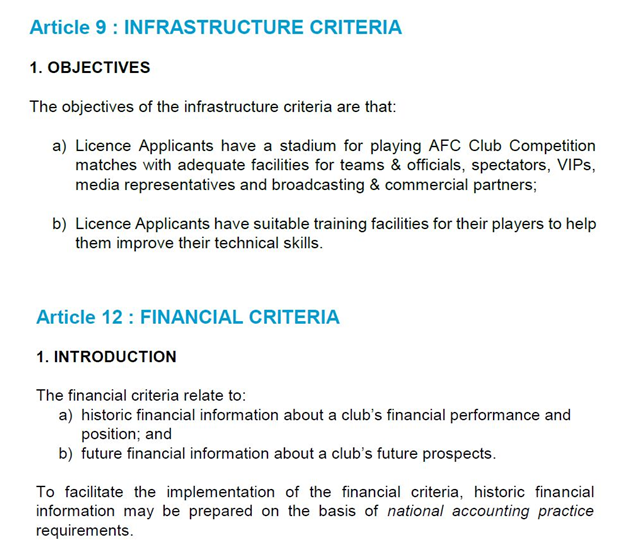
So I downloaded the 70-page-long AFC club licensing criteria for 2016 and went through it to find out what these possible reasons could be (the OCD kicked in)

I-league, ISL, Indian Super League, HeroISL, Merger, One league, Goa, Clubs, Exit, Leave, League, FIFA, AFCTo be honest, while the I-League clubs seem to be safe on the infrastructure demands, the financial part is slightly murky, with AFC wanting historic and future information. Clubs such has Salgaocar, which has relied on family wealth, might struggle to produce the required financial documents. Or so I think (I would love to be wrong).

Scroll reported that Salgaocar had failed to participate in the licensing process.

But one is to assume most clubs will be able to produce the required documents, considering how the likes of East Bengal and Mohun Bagan play in the AFC tournaments most seasons.

And mind you, while AIFF will not openly admit it, it’s the ISL clubs who will struggle a lot more to match the AFC criteria. For example the foreign player rule:

I-league, ISL, Indian Super League, HeroISL, Merger, One league, Goa, Clubs, Exit, Leave, League, FIFA, AFC

It doesnt mean the ISL clubs can’t take part. But they will have a lot of foreign players who won’t be allowed to play, which is an unnecessary burden on team wages. Will the foreign stars in the team be OK with missing out on Asia’s top league? Also, barring Goa, which other team has player with 3 foreign players or lesser, and succeeded in ISL?

The great Indian football league merger, at least according to me, should be delayed till ISL teams have more Indians playing. And once that is achieved, it can merge into I-League as one big, fat league (with around 16 teams) and we can thereafter replicate the 9-month league format that most countries have. Rather than rush to a merger, push ISL teams to  field more Indians, allow I-league to grow simultaneously, at least organically, if you do not want to promote it (AIFF has admitted that I-League TV viewership and stadium turn-out has increased every year), and in two years time, come up with a structure that benefits all stakeholders of Indian football. (Unified league in India likely after U-17 World Cup – Kushal Das)

But, my brain tells me AIFF and IMG-R won’t wait that long. Actually, AIFF Gen. Sec said it too.

If Oxford dictionary’s definition of ‘stockholm syndrome’ as “Feelings of trust or affection felt in many cases of kidnapping or hostage-taking by a victim towards a captor” is something to go by, then it perfectly describes the relationship between AIFF and IMG-Reliance. The Indian football federation seems to have completely lost the plot, and now, in its bid to survive, has developed an unjustifiable affection for IMG-R.

One can only be an Andy Dufresne (that’s your cue to watch Shawshank Redemption if you haven’t yet) and HOPE the merger will not mark the end of a legacy in Indian football.

This blog post is just a rant and it has nothing to do with my employers. In fact, I have a feeling they won’t like me so much after this. But, blah! As usual, I’m likely to make mistakes. I urge you to correct me wherever you think I’ve gone wrong..

Downloads:

You can download the AFC club licensing criteria here (page 33 infrastructure, page 55 financial): http://www.the-afc.com/uploads/afc/files/AFC_CLR_Booklet_2016.pdf

AFC Champions League competition regulations: http://www.the-afc.com/uploads/afc/files/acl_2015_competition_regulations_final.pdf

AIFF general secretary Kushal Das is living in a fool’s paradise – Sporting Clube de Goa

AIFF, Sporting Clube De Goa, Football, Indian Football, Goa, I-league, SCG, Flaming Oranje

Sporting Clube De Goa

The pull-out of Salgaocar FC and Sporting Clube de Goa should have been a wake-up call for the AIFF to at least now set its messy house in order but instead the federation, and its ignorant general secretary, have resorted to unnecessarily pointing the accusing finger at us. In an interview to a news agency and other media channels, Das said “FC Bardez have a bigger fan following than these clubs. I have seen them in the Goa Pro League.”

Kushal Das is really cut-off from the reality. To say that a four-month old club has more fan following than us is ridiculous and a huge insult to the contribution of clubs like Salgaocar FC and Sporting Clube de Goa, who have contributed immensely to the development of Indian football.

We wonder how many matches Kushal Das watched in Goa and how many I-League matches he has attended since becoming secretary?

For the ignorant Kushal Das’s knowledge, until some years ago, both clubs attracted massive crowd wherever it played. The Nehru Stadium, Fatorda, saw big attendances but since Praful Patel took over as president and Kushal Das was appointed secretary, the numbers have dwindled. Indian football’s slump is also reflected in the poor rankings and much of this is due to mismanagement by the AIFF.

The AIFF cannot blame the Goan clubs to hide its own inefficiency.

Indian football is at its lowest ebb and an ill-informed secretary doesn’t help its cause.

Kushal Das must remember that he is a paid employee of the AIFF. We have not made a living out of football but instead helped others make a living through football. It is clear that Kushal Das, who is occupying a wrong chair, has no clue about football in India and his comments reflect the deplorable state of AIFF at the moment.

Kushal Das is an embarrassment for Indian football. He must apologise for his comments which are shocking and uncalled for.

Mr. Victor G Fernandes
CEO.
SPORTING CLUBE DE GOA

AFC Cup 2016 Final – Know thy opponent : Through the words of an Iraqi Football expert

Air Force Club, JSW, Bengaluru FC, Al-Quwa Al-Jawiya, AFC Cup, 2016, Doha, Qatar, Sunil Chhetri, Hammadi, Star Sports, Football, Indian Football, Soccer, IraqThe big day is here. It is a momentous occasion for Indian Football as Bengaluru FC takes on Al-Quwa Al-Jawiya or the Air Force Club of Iraq as they are known in the AFC Cup 2016 final. Since there was a dearth of information on today’s opponent, I decided to get in touch with an Iraqi football expert to know more about Al-Quwa Al-Jawiya. I asked a few questions to football writer Hassanin Mubarak and here are his replies. Read on!

What’s is Air Force Club’s style of play?

Al-Quwa Al-Jawiya are an attacking side playing two forward up-front, with Hamadi Ahmed and the returning Amjad Radhi, one of the most prolific strikers in the Iraqi league in current times who is attempting to regain his old form. The little and large combination of Hamadi and Amjad were once the best two front-pairing in Iraq until Amjad left for Arbil in 2010. The striker wearing the No.40 for Al-Jawiya was top scorer in this tournament in 2012 with 9 goals. Amjad has spent the last couple of seasons in Saudi Arabia and Egypt without much success and while he was Al-Jawiya’s main forward during his last spell at the club, Hamadi has now taken on that mantle with Amjad being the second striker. Basim Qasim also has Emad Muhsin if needed. Al-Jawiya’s goals will depend a lot on the ability of the wide-men to create in the final third, the hopes of victory will rest heavily on the shoulders of Humam Tariq and 15-goal hit man Hamadi Ahmed.

Their Strong points and weakness according to you?

Al-Jawiya relies a great deal on the presence of Hamadi Ahmed, their main goalscorer and attacking threat. The new coach Basim Qasim appointed in the summer has not changed either the style or team formation since taking charge, however, they have proved to be resilient under the former Police Lieutenant and are unbeaten in the first six games under him. Basim Qasim will, however, have to reshuffle the ranks with the absence of center back Samal Saeed and winger Bashar Resan, two key players who will be suspended for the final. Bashar will be a significant loss, with the team balance on the wings with Humam Tariq on the opposite flank interrupted, with both players having the talent to switch flanks throughout matches. While Basim Qasim has a ready-made replacement for Samal Saeed, in Saad Natiq, however the coach does not have that luxury with a replacement for Bashar. One solution would be to start Hulgard Mulla Mohammed, the brother of the retired wing wizard Hawar. He is a different proposition for defenders compared to the pacy and tricky Bashar Resan. Hulgard does not possess the speed he once had but the versatile two-footed attacking midfielder can play on the wings or in central midfield. But the absence of Bashar will be a substantial miss for Al-Jawiya.

Are they going to play the same way in the final or are you expecting a cagey game from them? Who are all the players to watch out?

I expect Al-Jawiya will play their usual game in Doha and go out and score goals. It could be a cagey and cautious final if the game remains goalless. The key players will be Humam Tariq out on the wings and Hamadi Ahmed, they could be the winning formula for Al-Jawiya.

Are you expecting to see a lot of fans in Doha supporting the Air Force club?

There won’t be many Iraqi fans traveling and a majority of the supporting contingent will be expatriates living in the tiny Gulf state.

What’s the talk among the Iraqi football fans about Bengaluru FC?

Little is known about Bengaluru FC among both the Iraqi fans and the Al-Jawiya players but with both teams in a final, the opposition will be respected. 23 years ago Al-Zawraa, one of the most successful clubs in Iraqi football history were humiliated 6-2 by the East Bengal Club so Iraqis will be wary of this very fact.

Follow Hassanin Mubarak on Twitter here.

You can read his extensive preview of Al-Quwa Al-Jawiya here.

1 2 3 11